Cashew

Employment and challenges in West African countries

The cashew nut grows on trees that are common in West African countries such as Côte d’Ivoire, Benin and Senegal. The cashew nut is playing an increasingly important role in the economy there, mainly due to growing demand.

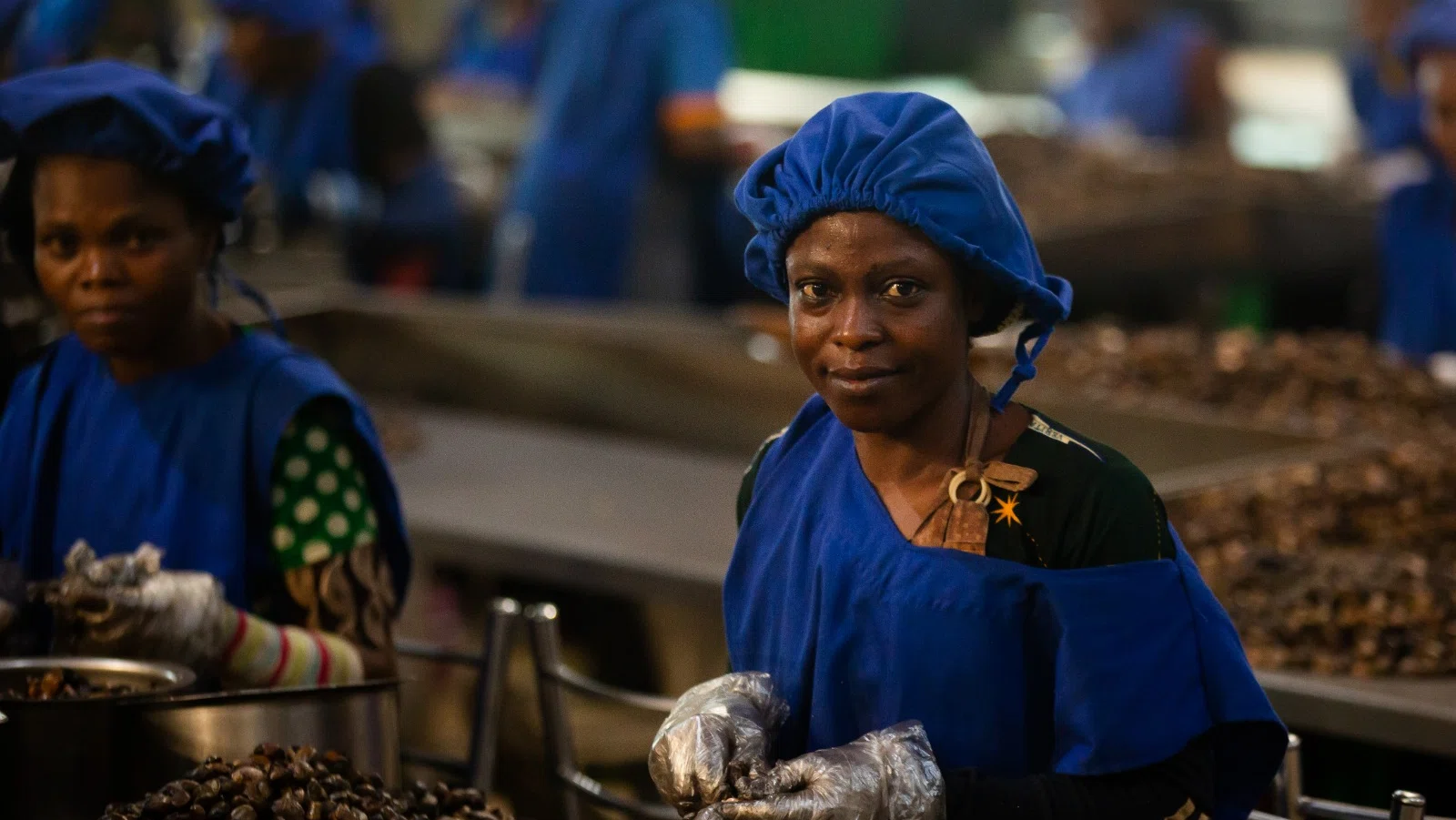
Tens of thousands of workers in vulnerable positions are indispensable to the global supply chain. A large proportion of the work is carried out by women. They face major challenges, such as poor working conditions, job insecurity and a lack of protective equipment. Their work in the cashew sector is hard, both in the fields and in the factory.

What is happening?

Improving working conditions and terms of employment in the cashew sector

Harvesting and processing cashew nuts is labour-intensive. First of all, after harvesting, the nuts are roasted in their shells at the factory. This makes it easier to remove the shell. The husk is also removed. This contains a toxic substance that can cause severe skin irritation.

This work therefore requires good protective gloves and equipment, as well as safety measures. In practice, these are often lacking. This is partly because, in many countries, there is hardly any monitoring due to a poorly functioning labour inspectorate.

Most of the workers are women. They are employed in the informal sector and are often in a vulnerable position. This is because, in both agriculture and factories, they usually do not have permanent jobs. As a result, it is particularly difficult for them to stand up for their own interests.

Key players in the West African cashew supply chain

This industry has given rise to a supply chain linking Africa, Asia and Europe. The key players are independent farmers or cooperatives, buyers, processors and exporters.

Only a small proportion of cashew nuts are processed in Africa itself. Most cashew nuts are shipped to the other side of the world. In countries such as Vietnam and India, cashew nuts are processed into edible nuts in a few steps.

Cashew nuts are mainly harvested informally by small-scale producers. In countries such as Benin and Côte d’Ivoire, the government sets the prices for cashew nuts. However, supply is lower than the combined demand from foreign and local companies. This creates tension between external and internal demand.

Challenges in cashew production and working conditions

The cashew sector faces a range of socio-economic challenges:

  1. Value addition through local processing
  2. Health and safety in the workplace
  3. Decent working conditions
  4. Employment for young people and women
  5. Environmental and social sustainability
  6. The informal nature of the work
  7. Involvement of the rural community

These challenges make strengthening cooperation between stakeholders crucial for the sector’s development. Against this backdrop, CNV Internationaal commissioned a study into the cashew sector in Côte d’Ivoire to provide greater insight into these dynamics.

Our approach

Research
Solutions

The study of the cashew sector takes into account changing legislation relating to national and multinational companies.

In particular, it focuses on the European Union’s new Corporate Social Due Diligence Directive (CSDD), which aims to promote sustainable business practices.

Download and read the full study via the link below:

Uit dit onderzoek komen verschillende oplossingen naar voren om de problemen aan te pakken: 

  • Strengthened social dialogue: Trade unions, cashew producers and governments must come together to improve workers’ labour rights. This social dialogue ensures that responsibility is not borne solely by local producers and cashew processors through certification schemes and standards.

    In this social dialogue, the position of workers in processing companies must also be represented, which is not currently the case. To kick-start the discussion on this issue, the European Union’s new Corporate Sustainability Due Diligence Directive (CSDDD) could serve as a starting point for discussions on improving labour rights.
  • Improved transparency regarding working conditions: The sector urgently needs greater transparency and reliable information on working conditions. Through dialogue with workers and transparency on the part of producers, we can strive for improvement.
  • Greater formalisation of the supply chain: This involves encouraging trade union membership, safeguarding the interests of farmers and factory workers, and establishing a clear role for representative organisations.
  • Promoting profitability for local farmers: To ensure market stability, local farmers and organisations must be supported through fixed-term contracts and investment. This provides greater income security. At the same time, it also improves living conditions in the region. Innovative solutions for utilising cashew waste can also contribute to this.

Mapping the cashew sector

Based on our research, we have developed a clear infographic summarising the key developments, challenges and opportunities in the cashew sector in Côte d’Ivoire. Among other things, the infographic illustrates the structure of the supply chain, which groups are most vulnerable, and where the greatest scope for improvement lies. Mapping the cashew sector

Our impact

CNV Internationaal is working to improve conditions for workers in the cashew sector through a supply chain approach. In West Africa, we are collaborating with partners in Benin and Côte d’Ivoire.

Towards a fairer and more inclusive cashew supply chain in Côte d’Ivoire

Whilst the cashew sector in West Africa has great potential, it also faces major challenges. The efforts of organisations such as CNV Internationaal are vital to ensuring a fair, sustainable and inclusive supply chain that benefits all workers, particularly the most vulnerable.

Opportunities arising from the new CSDDD legislation

The new European CSDDD legislation offers opportunities to tackle these issues. The law is designed to encourage companies to take responsibility and ensure decent working conditions throughout their supply chain.

It is essential that organisations, governments and stakeholders work together to tackle these challenges. Only in this way can a sustainable future for the cashew sector in Côte d’Ivoire be achieved.

Thanks in part to funding from the Ministry of Foreign Affairs in a number of countries, including Côte d’Ivoire, CNV Internationaal is able to contribute to the improvements mentioned and to international CSR in the cashew sector.

To limit and prevent labour rights violations, all stakeholders in the supply chain must be involved. The costs of reducing and preventing labour rights violations must be factored into the overall supply chain. The market must give ‘preferential treatment’ to companies that are working to improve conditions.

Fortunately, this is something that various stakeholders are already working on, so there are certainly opportunities for partnerships.

It is important to maintain a broad focus in this regard. After all, social sustainability does not stand alone; it is part of the wider sustainability challenge, which also encompasses environmental and business perspectives. All in all, this is a sector that is moving forward and seizing opportunities to comply with the new EU regulations.

The cashew sector in Benin

In Benin, cashew nuts and karité (shea butter), together with cotton, are important agricultural products. In Benin alone, an estimated 800,000 people work in the sector.

Cashew harvesting is mainly informal work carried out by small-scale producers. The government sets the price of cashew nuts and shea.

Foreign companies and investors often buy up the bulk of the harvest, leaving insufficient quantities for local businesses.

Benin therefore intends to increase the processing of cashew nuts within the country in the coming years.

Opportunities and challenges for workers

In Benin, CNV Internationaal works in partnership with the trade union COSI-Benin.

To begin with, the trade union campaigned for better safety equipment and improved working conditions. Training sessions have also been organised on trade union work, such as standing up for workers’ rights and, in particular, the right to collective bargaining. These are internationally recognised rights enshrined in conventions of the International Labour Organisation (ILO) (Conventions 87 and 98).

COSI Benin’s efforts also focus on ensuring access to universal health insurance and on combating violence and sexual harassment in the workplace.

In recent years, our partner trade union COSI Benin has successfully initiated social dialogue with companies such as FLUDOR S.A., aimed at improving the working conditions of thousands of cashew and shea workers.

It was new to us that a trade union was involved in a company’s growth.

Barbara Muriel Macon, Sustainability Manager at Fludor Benin
Benin improving labour rights for agriculture workers

Improving labour inspection and working conditions in the agricultural sector in Benin

Work in agriculture is hard, and often too little is done to protect farm workers from hazardous substances in plant protection products. The labour inspectorate does not take sufficient action against abuses.

The COSI trade union champions the interests of agricultural workers and is campaigning for the ratification of Convention 129 of the International Labour Organisation (ILO) on labour inspection in the agricultural sector.

Unfortunately, ratification has not yet been achieved. However, thanks in part to the efforts of the COSI trade union, the necessary preparations are now being made, as this video shows.

Trade unions and employers’ organisations are supporting this process. That is a valuable lesson. I hope this will happen more often.

Raymond Zounmatoun, Director of Labour Standards – Directorate-General for Employment

Fair Impact Programme

Strengthen your Human Rights Due Diligence (HRDD) with practical tools, training and support for fair and responsible value chains. Explore the opportunities for your business to make an impact.

Resources

Contact us

Get in touch

Francisca van Dusseldorp
Regiocoördinator Afrika
Marjolein Groenewegen
Programme Manager Africa