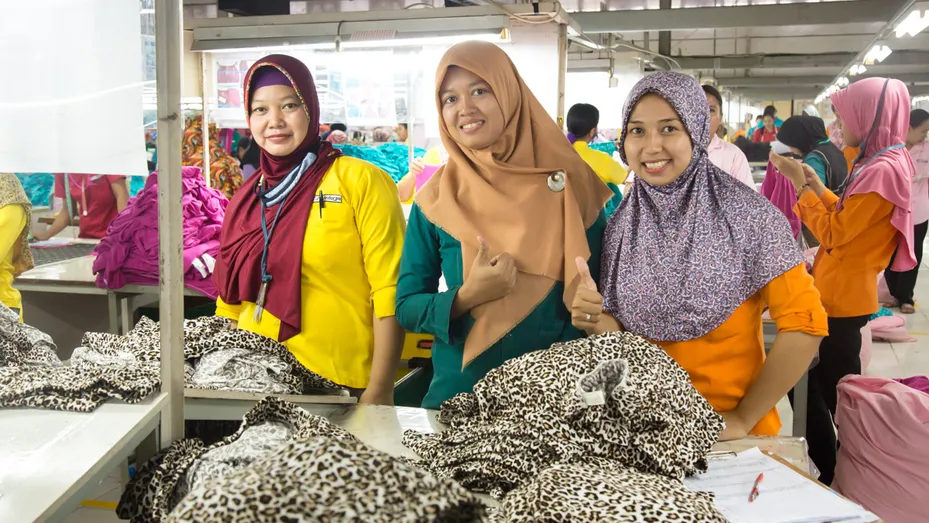
It is not always easy for companies to understand their suppliers' labour risks. Through our network of trade unions, CNV Internationaal can play an important role in working with companies to make a positive impact in their supply chains. Through the deployment of our Fair Work Monitor and the concept of multi-company collective agreements, we can contribute to transparency, monitoring and sustainable improvement together with companies.

New Alliance for Sustainable Clothing, Textiles and Shoes
Brands and organisations can apply from now on
The Textile Alliance
The Textile Alliance builds on the Covenant on Sustainable Clothing and Textiles (CKT), which operated from 4 July 2016 to 31 December 2021. This covenant focused on achieving substantial improvements within the supplier chain of clothing and textile production. It provided companies with tools to remedy the negative impact of their activities and supported them in jointly addressing problems that individual companies could not solve alone.
Working together for sustainability
Afterwards, there was a clear need from participants and stakeholders to move forward together. Also recent research by the Authority Consumer & Market (ACM)confirms that need:
“ More than 90% of companies recognise the need to cooperate with buyers and suppliers in their sustainability efforts. ”
ACM
That is why industry organisations Modint and InRetail, Mondiaal FNV, FNV and CNV Internationaal have collaborated within the SER on a new textile alliance. This way, we facilitate a platform for sectoral cooperation for tangible impact in the apparel, textile and footwear sector.
Why is it important for companies to join the Textile Alliance?
Participation in the Alliance enables companies to make an impact based on the OECD Guidelines for Multinational Enterprises. These make clear what the Dutch government (and 50 other countries) expects from companies when doing business internationally in terms of corporate social responsibility (CSR).
They also position companies proactively for emerging legislation around sustainability and CSR, such as the Corporate ustainability Reporting Directive (CSRD) and the Corporate Sustainability Due Diligence Directive (CSDDD).
This is not only beneficial for dealing with regulation; it also improves companies' reputation with consumers, investors and partners.
New regulations ban products with forced labour on European market
New regulations, such as the Forced Labour Regulation, require companies to actively demonstrate that they prevent forced labour within their chains. This requires a thorough due diligence approach.
The Textile Alliance offers a collective approach that is necessary in the fight against abuses that often go unnoticed in the supply chain.
What does Due Diligence entail?
The Alliance applies the OECD Guidelines for Corporate Social Responsibility. This means that companies must screen their supply chains to identify and address risks related to human rights, working conditions, the environment and animal welfare.
Key areas of focus include:
- Transparency: Companies must make production processes transparent on a step‑by‑step basis.
- Risk analysis: Focus on key risks such as forced labour and freedom of association.
- Responsible sourcing: Promote sustainable relationships with suppliers.
- Complaints mechanism: Provide a safe platform to raise concerns about working conditions.
- Monitoring & Reporting: Require annual reporting to ensure transparency and accountability.
Advantages
Participation in the Textile Alliance offers companies several benefits to meet sustainability and due diligence requirements. Here are the main ones:
- Network & stakeholders: Access to experts in high-risk countries such as Cambodia, Indonesia and Vietnam , which is essential for compliance.
- Model policies & tools: Useful models and roadmaps for immediate implementation.
- Training & advice: Practical training focused on labour rights and trade union freedom.
- Automated monitoring: Efficient progress monitoring without unnecessary administrative burden.
- Adaptations to legislation: Ahead of future regulations through alignment with relevant directives.
- Flexibility: Companies can set their priorities within risk modules.
Signing up new participants
Want to know more about joining the Alliance for Sustainable Clothing, Textiles and Footwear?
Contact CNV Internationaal

Or contact Modint
Miriam Geelhoed at geelhoed@modint.nl.
Together we can pave the way to a sustainable future for the garment sector