

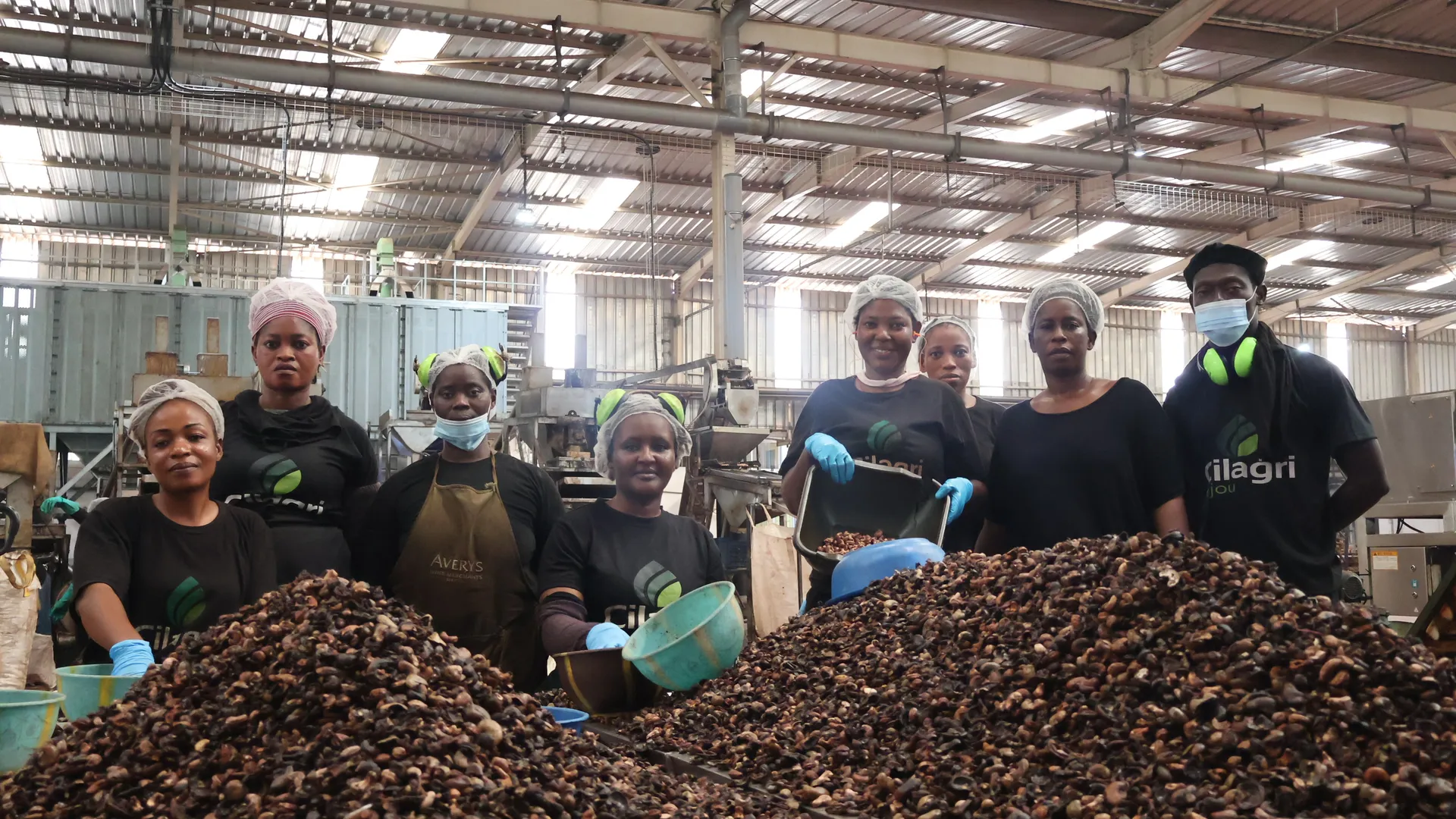
Cashew is of major economic importance to Côte d’Ivoire. The country produced around 1.5 million tonnes of raw cashew nuts in 2025. Cashew nuts are often being shipped to Vietnam to be shelled and processed further. At the same time, Cote d'Ivoire it is processing an increasing share of its nuts domestically, allowing more value and employment to remain in Côte d’Ivoire.
This development offers opportunities. But the question is not just how many jobs the sector creates. Equally important is what kind of jobs they are.
Low wages, insecure work and health risks
The new paper Cashew and decent work in Côte d’Ivoire: Putting workers at the centre of trade shows that workers in the cashew supply chain face a range of challenges.
Many workers in processing factories have no permanent contract and are hired on a temporary or even daily basis. CNV Internationaal and its trade union partners also report problems related to low wages, long working hours, occupational safety, and barriers to freedom of association.
The work itself can also pose risks. When shelling cashew nuts by hand, for example, workers may come into contact with corrosive liquid from the shells. On plantations, risks include pesticides, heavy lifting, machetes, snakes and scorpions.
Women’s situation deserves particular attention. They make up a large proportion of processing workers, yet are disproportionately represented in temporary jobs and far less represented in permanent and managerial positions.
No sustainable sector without workers’ voices
A key problem is that workers have limited representation.
The right to organise in a trade union and bargain collectively with employers is essential for decent work. After all, how can an individual worker raise concerns about unpaid wages, unsafe conditions or unfair dismissal when they fear they will not be hired again the next day?
That is why CNV Internationaal calls for workers and independent trade unions to have a permanent role in shaping the sector’s development.
Now is the time for the European Union to make a difference
The economic relationship between the European Union and Côte d’Ivoire makes this all the more urgent.
In July 2026, the EU and Côte d’Ivoire launched negotiations on a Sustainable Investment Facilitation Agreement (SIFA). This agreement aims to encourage sustainable investment and improve the investment climate.
For CNV Internationaal, this is an important opportunity to ensure that economic growth genuinely benefits workers.
Our recommendations therefore include:
- A concrete, funded action plan for decent work, with measurable commitments on issues including contracts, wages, social protection, occupational safety and collective bargaining.
- Stronger labour inspection and workplace protection, both on plantations and in processing companies.
- A lasting voice for workers and independent trade unions in the implementation of the agreement.
- Independent monitoring to establish whether investments genuinely lead to better working conditions in practice.
Cashew deserves explicit attention in this process. Sustainability in the cocoa sector is already an important topic in the negotiations. CNV Internationaal believes that labour rights in the cashew supply chain must also be explicitly addressed.
Working together for decent work in cashew
In Côte d’Ivoire, CNV Internationaal works with trade unions and organisations in the cashew sector to promote safer work, respect for labour rights, access to social protection and a stronger voice for workers.
One important partnership is with Intersyndicale Anacarde, which brings together five nationally representative trade unions working on the cashew sector. We also work with producer organisations and cooperatives.
Activities on social dialogue and the monitoring of working conditions are being developed with producer cooperatives and selected companies. CNV Internationaal also plans to conduct a Fair Work Monitor in 2027. This will ask workers directly about their wages, working conditions and other issues.
This information helps trade unions agree on concrete improvements with employers, governments and companies in the international supply chain.


